
IMD Business School MBA Application Guide
How to get into IMD, with insider guidance from Fortuna’s team of MBA admissions experts.

About IMD Business School
IMD was formed in 1990 through the merger of two decades-old schools: IMEDE, founded by Nestlé in 1956, and IMI, founded by Alcan in 1946. Since then, it has earned a place among Europe’s elite business schools. The IMD MBA is a one-year program that runs January to December in Lausanne, with a class of about 80-90 students and a student-to-faculty ratio of 1:2. A class of that size allows the staff to get to know every participant individually, starting with relocation and housing assistance and a partners’ integration program for those who move with a spouse or family.
IMD describes the MBA program as “a 12-month leadership-focused journey of real-world learning,” and the admissions process matches that focus. Promising candidates are invited to an Assessment Day, held online or on campus, that combines a personal interview with individual and group tasks modeled on the MBA classroom. Applicants typically prepare and present a short case on their own, then work through a second case in a small group and present the group’s conclusions, allowing the admissions team to observe candidates’ thinking and collaboration before admitting them.
IMD’s full name, the International Institute for Management Development, further emphasizes its focus on leadership development and global business exposure. Founded by businesses for businesses, the school remains closely tied to the Lausanne region’s concentration of multinational headquarters in finance, luxury, healthcare, and consumer goods, and MBA students draw directly on that ecosystem. IMD says more than 40% of the program happens outside the classroom, and every student works with an early-stage startup from January and, in the second half of the year, on a seven-week consulting project for a multinational or non-profit.
The insights on this page reflect Fortuna’s collective experience guiding applicants through IMD MBA admissions, including perspectives from our coaches who have reviewed MBA admissions files for IMD and its closest European peers.
Why Choose IMD Business School?
IMD draws candidates who want an intensely personalized, fast-moving MBA year inside a very small cohort, and who are comfortable being evaluated in action rather than only on paper.
Here are the factors that most distinguish the IMD MBA program:
A small, close-knit, focused class. With about 80-90 students and a 1:2 student-to-faculty ratio, IMD’s MBA is smaller than almost any peer program, and the school builds the year around that scale, from a personal leadership coach for every student to a career team that knows each person’s target list.
“A class this size means faculty and career advisors get to know your name and your story,” adds Karen Ponte, a Fortuna Coach and former Senior Manager at London Business School. “That level of individual attention can be a game-changer, and a real trade-off against a bigger alumni network. Applicants should be honest with themselves about which one they want.”
Experiential learning from week one. More than 40% of the program is hands-on: a startup project from January, a seven-week International Consulting Project with a multinational, two one-week Discovery Expeditions, and, new for the Class of 2027, a Future Lab that takes the class to Singapore in June and Shenzhen for the final week.
Deep ties to Switzerland’s corporate ecosystem. IMD’s Lausanne base sits inside a dense concentration of multinational headquarters in finance, luxury, healthcare, and consumer goods, and the program’s industry mix and recruiting base reflect that proximity more than most European MBA programs. IMD reports that 60 to 70 companies take part in its MBA recruiting each year.
IMD MBA Class Profile Class of 2026
| Average GMAT | 615 |
| Average GRE | Accepted; not published |
| Class Size | 90 |
| Nationalities | 34 |
| Average Age | 30 |
| Average Work Experience | 6 Years |
| Women | 34% |
| Tuition and mandatory fees | CHF 97,500 (CHF 80,000 + CHF 17,500) |
Curriculum Highlights
IMD’s one-year MBA runs January to December and is built for intensity and immediate application. The program focuses heavily on experiential learning, and the second half shifts almost entirely from the classroom to live projects.
Core Foundation: An accelerated core covers finance, strategy, leadership, and operations early in the program, with sustainability and digital trends integrated across the core classes. Classes run in morning and afternoon blocks built around discussion and group work.
Startup Project: From January to April, every student works in a team with an early-stage, high-tech startup, the first of the program’s live engagements.
International Consulting Project: In the second half of the year, teams of five or six spend seven to eight weeks, with no classes, working inside a multinational on a real strategic problem. Recent project partners have included Ferrari, the International Olympic Committee, and UEFA.
Discovery Expeditions and the Future Lab: Two one-week trips take the class to markets where, in IMD’s words, “the future is being shaped,” including Singapore. Starting with the Class of 2027, the Future Lab extends that with a June stint at IMD’s Singapore campus and a final week in Shenzhen.
Leadership Stream: Every student has a personal coach for the full year and 20 individual sessions with a psychoanalyst or personal development coach, alongside a two-day Leadership Lab retreat, a series of half-day “Right vs. Right” ethics debates, and a two-day session with Professor George Kohlrieser. The stream reflects IMD’s institutional focus, visible in its full name, on leadership development as much as functional training.
Electives and Internship: Students choose four or five electives from a list that includes sustainable finance, data and AI, marketing, and luxury, and can take an optional eight-week summer internship in July and August.

Career Outcomes (Class of 2025)
| Median Salary After Graduation | $136,940 |
| At least one job offer within 3 months of graduation | 78% |
| Post-MBA Industries | Consulting: 27% Manufacturing: 18% Technology: 16% Financial Services: 11% FMCG and retail: 9% Energy: 9% Other: 6% |
| Top Recruiters | ABB, Accenture, Almatis, Anglo American, BCG, Eli Lilly, Emerson, EY, Ferrero, Hoffmann Group, Intersport, Kearney, McKinsey & Company, Red Bull, and Tata |
IMD MBA Application Deadlines & Fees
IMD runs six application rounds a year for its single January intake, each paired with an Assessment Day about ten days later (online) and the following weekend (on campus in Lausanne). Earlier rounds compete for more scholarship money, and IMD asks admitted candidates to pay a CHF 10,000 deposit within two to four weeks of the offer.
For exact dates for IMD and other top MBA programs, see Fortuna’s MBA Application Deadlines tracker.
The IMD application fee is CHF 150 and is non-refundable. IMD MBA tuition is CHF 80,000, plus CHF 17,500 in mandatory fees that cover the pre-program course, travel and accommodation for IMD-organized projects, leadership and career coaching, books, and lunches on campus days, for a total of CHF 97,500.
IMD also estimates living expenses at about CHF 36,000 for a single student. About 48% of students receive a scholarship or bursary, more than half of them women, through awards including the CHF 50,000 MBA5 Scholarship, the CHF 50,000 Hilti STEM Scholars Program, the CHF 40,000 Nestlé Scholarship for Women, the CHF 30,000 Forté Scholarship for Women, and merit scholarships of up to CHF 40,000 that weigh Assessment Day performance.
IMD Admissions Process & How To Get Into the IMD MBA Program
Below is our guidance on each stage of the IMD MBA admissions process, in the order our successful clients typically complete them. For tailored, start-to-finish support from our team of former admissions insiders, explore Fortuna’s All-Inclusive MBA Package.
1. CV
IMD asks for a one-page CV using its own template, and it does not accept other formats. With a class this small and this experienced, density matters: every line should point to scope, leadership, and impact.
For more, read our guide: How to Write an MBA Resume That Stands Out.
2. Reference
IMD requires just one professional reference, submitted through its own online form from a work email address, which makes the choice of recommender particularly consequential. Pick someone who can speak in specific, recent detail about how you lead and operate, over the most senior name available.
3. IMD Application Essays
The IMD application essays for the 2026-27 cycle are two required prompts and one optional, each capped at 400 words.
Essay 1 (400 words): “Tell us your story.” This is an open narrative prompt, and the strongest responses focus on two or three defining experiences that shaped your values and how you lead, with a throughline connecting them.
“IMD is asking for a story that expresses, earnestly, who you are and how you think,” says Melissa Jones, a Fortuna Senior Expert Coach and former Assistant Director of the INSEAD MBA Program. “Your goal is to sift through your professional and personal experience to find examples that are emblematic of how you will show up on the MBA program. Give the admissions committee a glimpse of who the person behind the facts and figures of your resume really is.”
Essay 2 (400 words): “What areas of personal and professional development do you hope to explore during your time at IMD?” This prompt rewards self-awareness. Name a real gap, connect it to something concrete in the program, such as the leadership coaching, the International Consulting Project, or the Future Lab, and show what you are ready to give as well as gain.
Optional Essay (400 words): “Additional information that would be helpful for the Admissions Committee to be aware of?” Use this for material context the rest of the application does not otherwise cover, such as an academic gap or an unusual career transition, and keep it factual and brief.
For prompt-by-prompt guidance, read our article: IMD MBA Essays: Questions, Tips & Strategies.
4. Assessment Day and the IMD MBA Interview
Shortlisted candidates are invited to an Assessment Day, online or on campus in Lausanne, roughly ten days to two weeks after each deadline. The IMD Assessment Day is a mix of individual and group tasks plus an interview. In practice, that means a 30- to 60-minute personal interview with a member of the admissions committee, an individual case you prepare in about half an hour and present to an evaluator, and a group case discussed with a handful of other candidates and presented as a team.
Non-native English speakers also have their English assessed here. Merit scholarships weigh your Assessment Day performance, so the day decides more than admission.
“IMD, somewhat unusually, auditions you for the classroom before you’re admitted to it,” says Karen Ponte, a Fortuna Coach and former Senior Manager at London Business School, who authored Fortuna’s guide to the IMD essays. “Assessment Day absolutely rewards a polished individual pitch, but don’t forget they’re also examining how well you collaborate and work with others. The committee is interested in how you, as a class, challenge and build each other up.”
To prepare for the IMD interview, explore Fortuna’s MBA Interview Prep service, or read our guide: How to Ace the MBA Interview.
5. Decision and Deposit
IMD returns decisions after each Assessment Day cycle, and admitted candidates secure their place with a non-refundable CHF 10,000 deposit due two to four weeks after the offer. Scholarship and bursary requests are made inside the application itself, so decide what you plan to apply for before you submit.
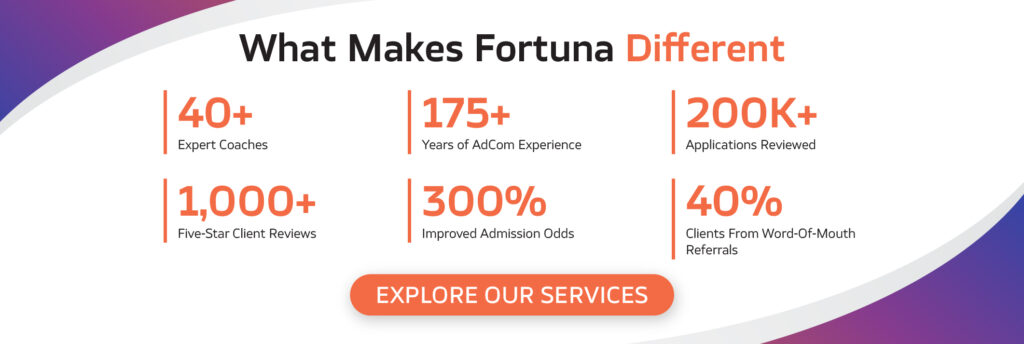
Expert Application Advice from Fortuna Coaches
Fortuna brings a cross-school view to IMD MBA admissions, drawing on coaches who have guided applicants into IMD and served on the admissions teams of its closest European peers. Our advice to candidates is that IMD evaluates you in action as much as on paper, and every part of the application should prepare the committee for the person who shows up on Assessment Day.
1. Consider the Personalized Approach
IMD prides itself on having a personalized admissions process and encourages applicants to connect with them from the outset. Remember that the school is keen to build a close-knit community of outstanding individuals who will make a real impact on the world, so reach out to the admissions team, students, and alumni to establish that connection. The website offers you the chance to have your profile evaluated – use that opportunity!
2. Clearly Communicate Your Work Experience
IMD students on average have around six years of work experience, slightly higher than some of the other top-tier schools, and the focus is on mature candidates who create a small class of 80-90. Be clear on the experience you’ve had to date and how that will add value to the class. The collaborative environment is a key element of the program, and you should demonstrate both what you bring and what you will gain from it. Show the skills and attributes you’ve developed and the progression you’ve achieved over this time.
3. Showcase Your Leadership Potential
The program is designed to nurture your leadership qualities, and the school is looking for individuals who have demonstrated the potential for strong leadership in their careers and lives so far. If you’ve had leadership experience at work (whether formally or informally), then be sure to communicate this clearly. Equally, if you’ve shown leadership skills in another capacity (extra-curricular activities, charity work, or even in previous academic settings) – then this is all valuable evidence.
4. Share Your Vision
IMD wants its graduates to go out into the world and really make a difference, so when you’re preparing your application, be clear on your goals – explain your motivations, your drive, and your ambition and show how you plan to make an impact. Consider your personal goals (be clear, specific, focused) but then go on to show how those goals ultimately will bring wider benefit. IMD has links with many companies that take part in recruitment events every year; do your research and show you’ve considered your first steps beyond the program.
5. Demonstrate Your Global Mindset
Though a relatively small class, the IMD MBA program offers a genuinely global environment – with an average class encompassing around 40 nationalities, the vast majority of whom will speak multiple languages. Show the international exposure you’ve had to date and how this has shaped you. Ideally, you will have worked in a number of countries, but if not, consider the diversity of the people you work with; the places you have traveled to and your passion for a globally focused career. It is vital that you come to the program with an open mind, a willingness to collaborate, and a genuine interest in the perspectives of others – consider all the elements in your profile that can evidence this and be sure to have your recommenders reference these points, too.
Next Steps: Start Your IMD Journey
IMD suits a candidate with a few years of real-world experience who wants one intense year in a class of 80-90, personalized leadership coaching, and live work for real companies from the beginning. It also looks for candidates who enjoy collaboration, building a class together, and who want to be judged in a room as well as on paper. Show IMD a clear story, an honest account of what you still need to learn, and the collaborator the committee will meet on Assessment Day.
Ready to pursue IMD? Partner with Fortuna’s team of MBA admissions experts to refine your strategy, strengthen your essays, and prepare with confidence. Book a free consultation to get started.
Frequently Asked Questions
IMD’s application for the 2026-27 cycle includes two required essays, “Tell us your story” and “What areas of personal and professional development do you hope to explore during your time at IMD?”, each with a 400-word limit, plus an optional 400-word essay for additional context. For prompt-by-prompt guidance, read our article: IMD MBA Essays: Questions, Tips & Strategies.
The IMD requirements are a bachelor’s degree or equivalent, at least two years of full-time work experience, a GMAT, GRE, or Executive Assessment score less than five years old (IMD recommends 555 or above on the GMAT Focus scale), a one-page CV in IMD’s template, one professional reference, two essays, and attendance at an Assessment Day. The application fee is CHF 150.
IMD MBA tuition is CHF 80,000, plus CHF 17,500 in mandatory program fees, for a total of CHF 97,500. The fees cover the pre-program course, travel and accommodation for IMD projects, leadership and career coaching, and learning materials. IMD estimates living costs at about CHF 36,000 for a single student, and 48% of students receive a scholarship or bursary.
IMD does not publish an official IMD acceptance rate. With a class of about 80-90 admitted through an Assessment Day that includes an interview and group exercises, the program is highly selective, and performance on the day counts as much as the written application.
For the Class of 2025, IMD reports average annualized total compensation of $136,940, about CHF 110,000, or $176,719 adjusted for purchasing power; 78% of graduates with at least one job offer within three months of graduation and 70% with an accepted offer; and 92% of graduates changing role, industry, or geography. Against total fees of CHF 97,500 for a single year out of work, the IMD career outcomes make a strong case for experienced candidates targeting leadership roles in consulting, industry, or technology, especially in Switzerland and the rest of Europe, where 71% of the class landed.
IMD’s one-year, full-time MBA in Lausanne, Switzerland, stands out for its small, experienced and highly international class. According to IMD’s 2026 class profile, students average 30 years of age and six years of work experience, and represent 34 nationalities. With a class of around 80-90, participants get close contact with faculty and personal coaching that is hard to find at larger schools. The program focuses on leadership and general management, with hands-on work such as the International Consulting Project and a startup project. In our experience at Fortuna Admissions, IMD suits candidates who already have real management experience and want to move quickly into senior leadership roles.
IMD’s Career Statistics 2025 report that 78% of the Class of 2025 had at least one offer within three months of graduation, with average annualized total compensation of $136,940 (about CHF 110,000). Consulting took 27% of the class, manufacturing 18%, technology 16%, and financial services 11%, with FMCG and retail and energy at 9% each; 71% of graduates stayed in Europe, 31% of them in Switzerland. Recruiters of the Class of 2025 include McKinsey & Company, BCG, Kearney, Accenture, EY, ABB, Eli Lilly, Ferrero, Red Bull, and Tata, and IMD says 60 to 70 companies take part in its MBA recruiting each year.
Yes. IMD accepts the GMAT, the GRE, or the Executive Assessment, with scores less than five years old.
The IMD MBA interview happens during the Assessment Day, online or on campus in Lausanne. Candidates sit a personal interview of roughly 30 to 60 minutes with a member of the admissions committee, prepare and present a short individual case, and work through a group case with a handful of other candidates. IMD evaluates candidates across the whole day, and performance impacts both admissions and scholarship decisions.
IMD has one intake each January and six application rounds. The IMD application dates for the January 2028 class are January 26, March 16, May 4, July 13, September 7, and October 12, 2027. Each round is followed by an online Assessment Day about ten days later and an on-campus one the following weekend. For guidance on timing, read our article: Round 1, Round 2 or Round 3? What MBA Applicants Need to Know, and for live dates see our MBA Application Deadlines tracker.
IMD’s MBA is a one-year, full-time program running from January to December, one of the more accelerated formats among top global MBA programs, with an optional eight-week internship in July and August.
IMD’s Class of 2026 numbers 90 students from 34 nationalities, with an average GMAT Focus score of 615, an average age of 30, six years of work experience, and 34% women. Europe supplies 39% of the class, North America 18%, South Asia 15%, Latin America 14%, East Asia 9%, and Africa and the Middle East 6%.
IMD’s MBA is ranked first in Europe in Bloomberg Businessweek’s 2026-27 Best Business Schools ranking, fifth among non-US programs by Poets&Quants for 2025-26, and 30th in the world in the Financial Times Global MBA Ranking 2026. IMD is accredited by AACSB, EQUIS, and AMBA.
IMD looks for experienced professionals, typically with three to eight years of work, who can show leadership with impact, global and cultural awareness, self-awareness, and a clear reason for wanting one intense year in Lausanne. Build the file around two or three experiences that changed how you lead, be honest in the development essay about what you still need, and prepare for Assessment Day as a simulation of a study group, since the committee weighs what it sees there as heavily as what you wrote. For a candid read on where your profile stands, book a free consultation with a Fortuna coach.