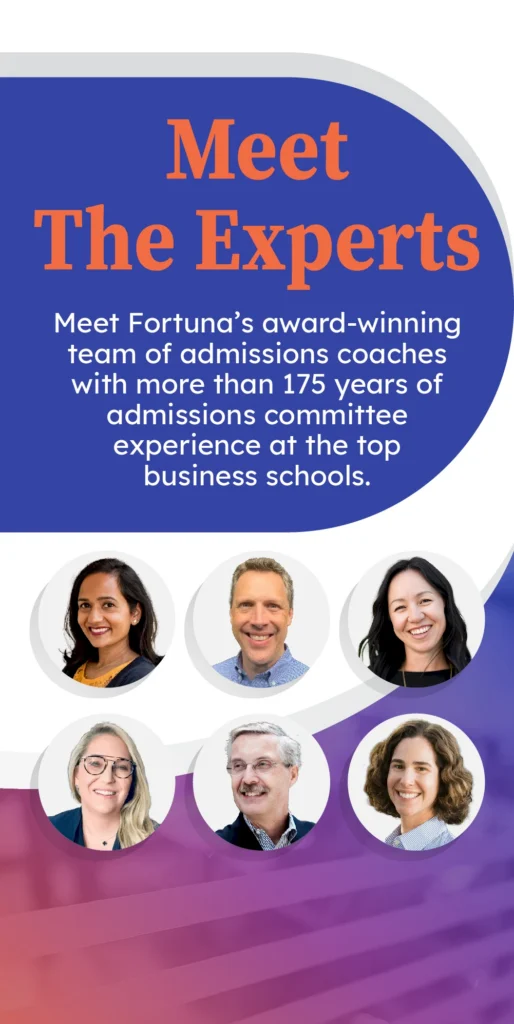



At Fortuna Admissions, we love to peer into the crystal ball and anticipate what lies ahead in the dynamic world of MBA admissions and business education, and we’re uniquely positioned to do so. Our team of former admissions directors and senior insiders from the world’s leading business schools works at the intersection of candidates and schools. What we’re seeing for the year ahead is not a single dominant trend, but a convergence of forces that will meaningfully shape the MBA admissions landscape.
After several years shaped by disruption from AI, geopolitics, immigration uncertainty, and shifting candidate priorities, business schools are entering a more grounded phase: one marked by greater intention, less noise, and a renewed emphasis on what cannot be automated.
Below are our key predictions for MBA admissions in 2026.
1. AI in Admissions: From Experimentation to Friction
If the last two admissions cycles revolved around whether AI would influence MBA applications, 2026 will be about where schools draw the line.
Candidates will continue to experiment with AI tools (often clumsily) while admissions teams become more adept at spotting applications that feel formulaic, or disconnected from an authentic human voice. The result is an emerging tension point: applicants attempting to leverage AI without sounding like it, and schools adapting their evaluation methods to surface genuine thinking and originality.
We expect to see:
- Increased use of video-based assessments to bypass scripted responses
- Less tolerance for overly polished, generic essays that lack specificity or personal insight
- Careful experimentation with AI-assisted tools behind the scenes, not to replace readers, but to support large-scale pattern recognition
Ironically, as AI becomes more prevalent, meaningful human differentiation matters more, not less.
2. Video Is Core
Video components, whether asynchronous interviews or short recorded prompts, are now firmly embedded in the admissions process across a wide range of programs, including Kellogg, MIT Sloan, Chicago Booth, INSEAD, and London Business School.
For admissions teams, video offers a way to assess communication, presence, and judgment in real time, while reducing reliance on heavily edited or AI-assisted written materials. It captures spontaneity, self-awareness, and how a candidate shows up under light pressure, which are qualities that are difficult to evaluate on paper alone.
For candidates, this does raise the bar, but not in the way many assume. Admissions teams are not looking for slick production, rehearsed delivery, or performative charisma. They want a true glimpse of who you really are, how you think, and how you would contribute as a classmate, whether in discussion, collaboration, and everyday interactions within the community.
Coherence matters. Essays, resumes, short answers, and video responses should reinforce a consistent narrative about your motivations, priorities, and way of engaging with the world. Noticeable shifts in substance or communication skills from one component to another weaken credibility.
Applicants who approach video as an extension of their broader story (rather than a standalone performance) will be best positioned. Those who treat it as an afterthought, or try to “act” their way through it, risk undermining their case for admission.

3. US MBA Applications: Strong Domestic Demand, Weaker International Interest
The current defining feature of the US MBA market is a divergence in applicant demand. Domestic applications remain healthy, driven by career uncertainty, slower white-collar hiring, and the MBA’s continued appeal as a structured path to reinvention. International applications, however, are likely to remain under pressure due to visa uncertainty, geopolitical tension, and increasingly compelling alternatives outside the US.
This imbalance will be felt across the market. Even top US programs, which continue to attract global interest, are likely to see smaller international applicant pools than in prior cycles. That said, overall competitiveness at the top is unlikely to ease, as strong domestic demand helps offset lower international volumes.
Mid-tier US schools, by contrast, will feel this shift more acutely. With fewer international candidates in the mix, these programs may need to adapt through expanded scholarship offerings, targeted outreach, or revised recruitment strategies.
For domestic US applicants, this subtly reshapes the competitive landscape. In certain segments, reduced international competition may create openings that were harder to access in previous years. Some strong US candidates who might previously have fallen just short at top programs may find themselves more competitive in 2026.
4. The “Trump Bump” at International MBA Programs
One notable second-order effect of softer international demand for US programs is rising competition at leading international MBAs.
Europe, in particular, is experiencing what some describe as a “Trump bump,” with globally mobile candidates redirecting their focus toward programs that offer strong career outcomes alongside greater geographic and visa flexibility. This is intensifying competition at a range of schools including INSEAD, London Business School, ESMT Berlin, and ESADE, and many more.
Candidates who once split applications between the US and Europe are increasingly concentrating on a smaller set of global programs they view as safer or more flexible long-term bets.
This redistribution of demand extends beyond Europe. Leading Asian business schools, particularly in India, China, Singapore, and Hong Kong, are also gaining traction among candidates seeking faster ROI, proximity to high-growth markets, and close alignment with local employer ecosystems. For those planning careers in Asia, these programs are no longer seen as secondary options, but as strategic choices in their own right.
The implication for applicants is clear: while international options are expanding, competition is intensifying. Strong academics and professional experience alone will not be sufficient. Clear career intent, thoughtful school fit, and a compelling explanation of why this program, in this location, at this moment, matter more than ever.
5. Essays Will Probe for Diverse Voices, Not Labels
While many US schools have removed explicitly DEI-framed elements from their applications, this does not signal a retreat from diversity of perspective. If anything, we expect schools to become more deliberate in how they surface it.
Essay prompts are likely to explore areas such as ethical judgment, leadership under ambiguity, moments of perspective shift, or experiences that have shaped how candidates see the world.
This shift is also pragmatic. As international application volumes soften, US programs can no longer rely as heavily on nationality alone to deliver classroom diversity. Instead, they will look more closely at how candidates’ professional paths, life experiences, values, and decision-making frameworks contribute to a genuinely multi-perspective learning environment.
For applicants, the message is consistent: demonstrate judgment, growth, and perspective. The strongest candidates will articulate not just what they’ve done, but how experience has shaped the way they lead, collaborate, and engage, and how their voice will add to a multi-dimensional classroom and enrich peer learning.

6. The Rising Premium on Human Skills
As AI becomes embedded across nearly every business function, differentiation increasingly comes down to judgment rather than output. When answers are abundant, advantage lies in interpretation, prioritization, and decision-making under uncertainty.
In 2026, admissions committees will be especially attentive to signals of:
- Self-awareness and learning agility
- The ability to frame problems before solving them
- Comfort with ambiguity and tradeoffs
- Communication that feels human rather than optimized
These qualities directly influence classroom dynamics, leadership development, and peer learning. Admissions teams are assessing not only whether candidates can succeed academically, but how they will engage, challenge ideas, listen, and contribute to collective growth.
7. Post-MBA Recruiting: Focused, Skills-Driven, and Entrepreneurial
The post-MBA hiring environment in 2026 is likely to remain selective and uneven across sectors and geographies. Employers are hiring with greater precision, prioritizing roles where MBAs can add immediate value amid technological and organizational change.
Across industries, a key differentiator is the ability to work effectively with AI rather than compete against it. Employers are looking for MBAs who can integrate AI into decision-making, workflows, and strategy: knowing when to rely on automation, when to question outputs, and how to translate insight into action. Strong change-management skills are increasingly essential, as many organizations struggle less with technology adoption than with helping people adapt.
Consulting and financial services will remain core MBA recruiters, with consulting benefiting in particular from ongoing transformation across industries. Technology hiring has stabilized in a more focused form, centered on roles that sit at the intersection of business and tech. Healthcare, sustainability, and energy transition remain longer-term growth areas, especially for candidates comfortable operating in complex, regulated environments.
We also saw a notable increase in MBA graduates pursuing entrepreneurship in 2025 (for example, 14% of the HBS class of 2025 started their own company): a trend we expect to continue. Lower barriers to entry, faster prototyping, and AI-enabled scale have made entrepreneurship a compelling path, not merely a fallback in a slow hiring market.
Final Thoughts
If there is a single thread running through our 2026 outlook, it is a renewed emphasis on the human dimension. As AI becomes ubiquitous and global dynamics shift, business schools are doubling down on what happens inside the classroom: real dialogue, real disagreement, and real growth.
Admissions decisions in 2026 are about who candidates are, not just what they have achieved: how they think, how they learn, how they engage, and how they show up alongside others. In that environment, the strongest applications will be grounded in lived experience, thoughtful judgment, and a clear sense of purpose. If you’d like an objective, experienced perspective on how your profile stacks up, book a free consultation.