


In Brief: From early August 2026, if you have taken the GMAT Focus multiple times, GMAC will automatically combine your highest Quant, Verbal, and Data Insights results across your tests into a single superscore on the 205–805 scale. GMAT superscoring costs nothing, requires no action from you, and appears on the GMAT score report you send to schools alongside the test (or tests) you choose to report. The feature gives admissions committees an at-a-glance view of your best GMAT section scores, but it only changes the presentation of your performance, not the substance of how you are assessed. Candidates should keep in mind that a strong single-sitting score still carries more weight than the same number reached only as a superscore, so that should remain your focus, and some schools will not look at the superscore at all.
If you have ever walked out of the GMAT having nailed the Quant but stumbled on the Verbal, only to do the reverse on your next attempt, GMAC’s newest feature has been designed for you. Below, we explain how the superscore works, what schools actually see, and how it should, or should not, influence your test-taking strategy. For a candid read on where the GMAT sits in your wider MBA application profile, book a free consultation with our team.
What Is the GMAT Superscore?
The GMAT Superscore is a single composite figure reflecting the highest score you have achieved in each of the three sections, even when those high points came from different test dates. GMAC calculates it automatically, on the same 205–805 scale as your Total GMAT Focus Score, and includes it on your report by default. If you have only taken the test once, or you have taken it several times but achieved your best result in every section on the same day, you do not have a superscore.
Here is a quick worked example. Say you sit the GMAT Focus three times and never quite line up your best sections on the same day:
| Attempt | Quant | Verbal | Data Insights | Total that day |
| First sitting | 82 | 78 | 80 | 605 |
| Second sitting | 79 | 81 | 82 | 615 |
| Third sitting | 81 | 80 | 84 | 635 |
| Superscore | 82 | 81 | 84 | 655 |
While your best individual attempt tops out at 635, your strongest section results combine into a 655. The superscore sits alongside your individual results; it does not overwrite or recalculate the scores you earned on any single day.

When It Launches
GMAC announced the superscore in mid-June 2026 and expects to roll it out in early August 2026, in time for the Round 1 cycle. Because it is calculated automatically from your eligible testing history, there is nothing to opt into or out of.
Why GMAC Introduced the Superscore
GMAC’s official rationale is candidate-focused: it frames the superscore as a way to reduce “score anxiety,” so that applicants with mixed results feel more confident submitting their scores. The likely commercial motive sits alongside that. The GMAT has lost ground to the GRE, and the superscore reads as an effort to shore up GMAT’s position. GMAC is no doubt hoping that the superscore will both encourage candidates to choose the GMAT over the GRE and nudge them toward testing more frequently.
What Schools Actually See
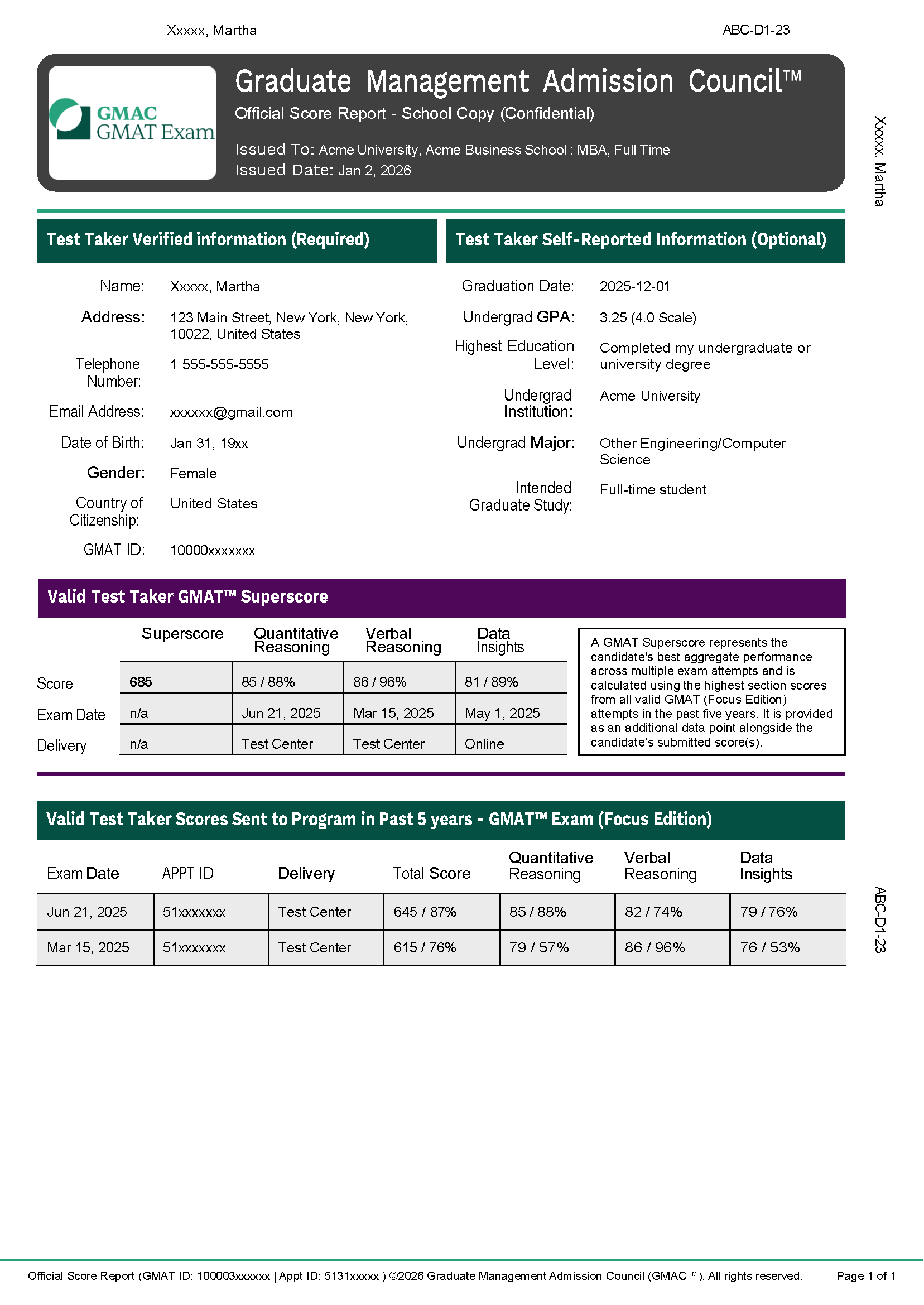
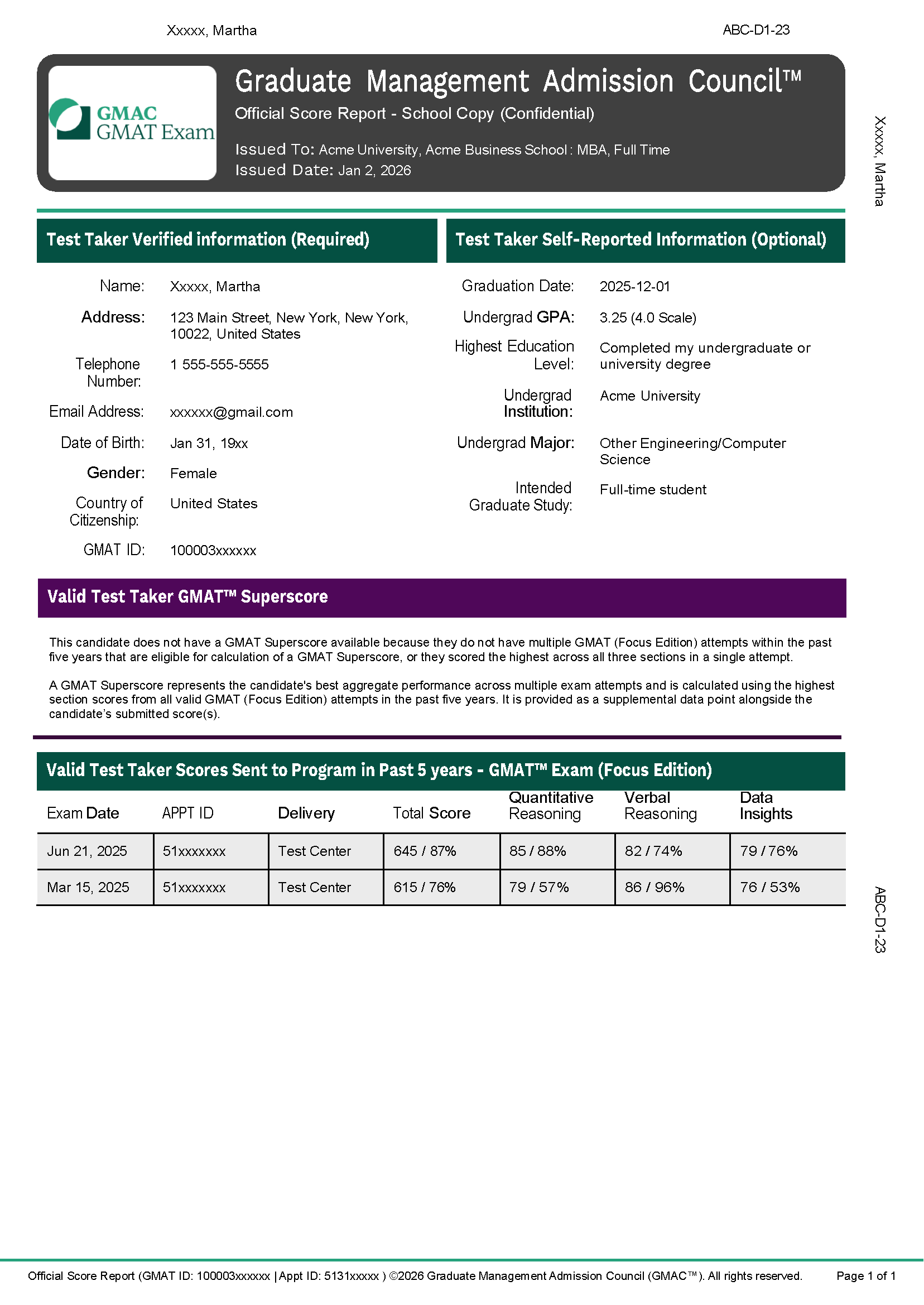
GMAT score sending works as before: you choose which sitting of the tests you want to report. When you send a single attempt after the feature goes live, the school receives these three things together on the GMAT official score report: the details of your results for your single-sitting, your superscore (if you have one), and the test dates that produced each of your best GMAT section scores in your superscore.
The superscore does not reveal all the details of the full set of attempts that feed into it. You still control which full results you submit, so schools will not automatically see the complete section-by-section breakdown of every test behind your superscore. You do need to submit the results for at least one single-sitting (i.e. you can’t only submit the superscore).
Here’s an example from GMAC of how a score report will look with a superscore, and here’s an example of how a score report will look where the candidate does not have a superscore.
Does the GMAT Superscore Affect MBA Admissions?
Practices for evaluating standardized test performance vary by school, and the superscore introduction will not change those policies, especially at the top business schools. Many admissions teams have been in the habit of looking across submitted scores and giving candidates some credit for reaching a given level on each part of the test, even when those levels were not reached in the same sitting.
For the schools that read across attempts, this is part of a holistic review of your academic readiness. However, it remains ideal to post your best result on every section in one sitting, and doing so still carries more weight. For example, a candidate who scores 685 in a single sitting will be regarded as having a stronger GMAT result than one whose 685 is a superscore built from lower individual totals.
Emma Bond, Fortuna Director and former Senior Admissions Manager at London Business School states: “We looked across all of a candidate’s scores. If someone had performed poorly in a particular section on their best overall sitting but had done better on that section in an earlier one, that would carry some weight. But the total score from a single sitting still had to be the benchmark, partly because of the timing component, and partly because superscores can’t be used in the class stats or reporting.”
So in practice, many schools have long looked across a candidate’s attempts and given some credit for the highest level they reached on each section. What has changed is the presentation, not the evaluation policy, and the candidate who would have been admitted before is the candidate who will be admitted now.
Keep in mind that for business schools, GMAT scores are just one data point (albeit important) within a holistic review that weighs your academic record, professional progression, leadership, and overall fit.
How Many Scores Can You Submit, and How They Are Evaluated
Below is a summary of policies at top schools. Essentially, you can submit multiple scores, but schools do not officially credit you with a superscore, and your highest GMAT (or GRE) from a single sitting is the one that carries the most weight.
HBS, Stanford GSB, and Columbia take the strictest stance, focusing their evaluation on a single test result rather than reading across your attempts. The other leading schools look across your full testing history, though the strongest single sitting remains the benchmark. We do not expect any of this to change as a result of GMAT’s new superscore policy.
| School | How many scores can you include on the application form? | How multiple scores are treated |
| Harvard (HBS) | You may enter multiple test results. | “If you submit multiple test scores from GMAT or GRE to HBS, we will only look at the score from your highest single test sitting.” |
| Stanford (GSB) | “If you have taken the GMAT or GRE more than once, report only the scores from one examination that you wish us to consider while reviewing your application.” However in practice, you can submit more than one test. | The school states it does not superscore and considers one test result for the purposes of evaluation. |
| Columbia (CBS) | You may enter multiple test results. | “The Admissions Committee will consider only your highest score when reviewing your application and will not combine sub scores from multiple exams into a single composite score.” |
| Chicago Booth | You may enter multiple test results. | “Chicago Booth does not accept test superscores.” However in practice, the school will review all submitted scores while giving the greatest weight to the best result from a single sitting. |
| Wharton | You may enter multiple test results; list highest first. | No explicit multiple/superscore policy. The school will review all submitted scores but gives the greatest weight to the best result from a single sitting. |
| Kellogg | You may enter multiple test results. | No explicit multiple/superscore policy. The school will review all submitted scores but gives the greatest weight to the best result from a single sitting. |
| MIT Sloan | You may enter multiple test results. | “If you took the exam several times feel free to submit multiple complete scores.” School states it will look across full testing history. |
| INSEAD | You may enter multiple test results. | Considers all attempts, weighting the highest most; may credit strong sections across two tests if neither shows too big a drop. |
| London Business School | You may enter multiple test results. | No explicit multiple/superscore policy. In practice, the school will review all submitted scores but gives the greatest weight to the best result from a single sitting. |

Answers to Critical Applicant Questions About the GMAT Superscore
If You Took the GMAT 10th Edition, or the GRE, Are You at a Disadvantage?
The superscore applies only to the current GMAT Focus Edition (launched end of 2023), so older scores will not feed into a composite. Neither are GRE test results presented with a superscore. Schools are well used to reading scores in the context of the relevant test, edition, and scale. If schools consider the candidate’s history of test taking, when a candidate submits multiple scores, they will continue to do so regardless of whether the candidate submits a GMAT Focus, GMAT 10th Edition or GRE. The addition or lack of a superscore on the score report confers no advantage or disadvantage.
Should the Superscore Change Your Testing Strategy?
No. As before, set your target GMAT score at or above the average reported by your target schools and aim to achieve that result in a single sitting. That is the best signal of academic readiness, and it remains the result schools weight most heavily.
Judith Silverman Hodara, Fortuna co-founder and former Head of Admissions at Wharton explains: “At Wharton, we’d give a nod to the fact that a candidate had done better on a section in an earlier sitting, but because of reporting we still had to use the best overall score from a single sitting. I’d add that the quant score carries the most weight over other sections of the test, especially for native English speakers.”
Should You Try to Maximize Your Superscore?
Your energy should go toward maximizing your best single-sitting result, not toward assembling a composite across multiple test dates.
Should the Superscore Change Your Retake Strategy?
No. Schools still give the most weight to your strongest single sitting, so the case for a GMAT retake rests where it always has: on whether another attempt would meaningfully lift that score. For example, if your GMAT Quant score is the weak point in an otherwise competitive profile, a targeted retake focused on Quant may be worth considering, especially if the school looks at more than one test result, but that was also the case before the superscore was launched.
Fortuna Co-Founder Judith Hodara advises: “Candidates should beware falling into a retake spiral, for example booking a fourth or fifth sitting to chase ten more points while their essays sit half-finished. Remember that the GMAT is just one component of the holistic review process, and applicants should balance their time and energy across the various elements of their application.”
Should the Superscore Change Which Scores You Submit to a School?
Here is where things might change a little. In the past, a candidate whose best sections were split across different dates had to submit two or three full results to convey their overall strength, exposing every weak section in the process. Now they don’t. For candidates with an uneven testing history, that is a very slight benefit: the strong sections come through, and the weak ones stay in the background.
The Bottom Line
The GMAT Superscore is a cosmetic change and the rules of admission stay where they were. Committees that were already crediting candidates for their strongest performance across attempts will do so as before. In all cases, a strong single sitting still outweighs a superscore.
The smartest approach is the one that was always true: prepare properly, test when you are ready, aim for a strong, balanced sitting.
Fortuna’s MBA admissions experts can help you weigh a GMAT retake strategy against your target schools’ expectations, decide whether to submit a score or pursue a waiver, and focus your time where it will have the greatest impact. Book a free consultation today.
Frequently Asked Questions
No. GMAC calculates it automatically from your eligible attempts, at no cost, and includes it on the official report you send to schools. There is no separate request.
Only sittings on the current edition of the GMAT, at a test center or online. Quick check: a total ending in 5 is the current exam and counts; a total ending in 0 is the retired edition and will not be included.
Possibly. A school sees your superscore only once you send a single attempt after the feature goes live. If you reported scores earlier and now have a superscore, send any single attempt to that program again so the report updates.
No. Many outstanding candidates take the test more than once. However, we recommend only taking the test when you feel fully prepared, and in the case of a GMAT retake, when you feel confident of your chances of improving your score.
No. The superscore draws your highest result in each section, so it will meet or exceed your strongest individual total. GMAC has not published every calculation detail, so wait for the final method before assuming precise figures.
No, you should stick with the GRE if you are best suited to this test; keep in mind that the GMAT Superscore does not confer an advantage, as outlined above.