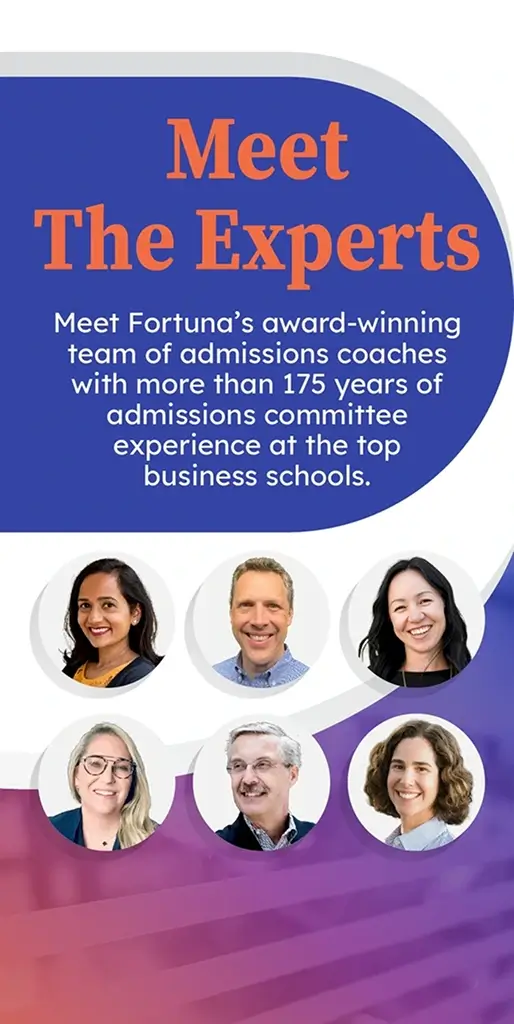



If you’re applying to business school right now, AI is part of your world – whether you’re an advocate of it or not. It’s in your inbox, in your feed, and maybe in your draft MBA application. As someone who spent years as Director of Admissions at INSEAD – reviewing and deciding on thousands of files – I want to be direct with you: it isn’t working in candidates’ favor.
MBA admissions essays are the part of the application where you show up as a real person – with your own story, reasoning, and voice. What admissions offices remember, and what moves the needle, is specific: the detail only you could have written, the reflection that couldn’t have come from anyone else. AI-generated essays, however polished, tend to flatten exactly that.
Judith Silverman Hodara, Co-Founder & Director at Fortuna and former Head of MBA Admissions at Wharton comments: “I worked with a candidate recently whose early drafts were pretty rough – understandable for someone still finding their voice. But then his third draft was very polished, verbose, and obviously AI-generated. It sounded nothing like him. Part of our job now is helping candidates sound like themselves again after AI has gotten involved – which is a strange place for the admissions coaching process to find itself.”
Furthermore, schools also have policies around AI usage, which candidates should scrutinize carefully. Some schools – HBS, Kellogg, Michigan Ross, and LBS – require formal AI disclosure with specific citation requirements; others may use AI detection tools to screen submissions. While policies differ across schools, the underlying expectation is consistent: your application should be authentically yours and accurately represent you and how you communicate.
AI Policies at Top MBA Programs
The table below draws directly from each school’s official application materials. Read the language carefully: in some cases the consequences for non-compliance include revocation of admission. (Note: The following schools have not published AI policies for admissions candidates at the time of writing this article: MIT Sloan, Chicago Booth, and INSEAD.)
| School | School’s Guidance on AI Usage |
| Harvard Business School | Have you utilized AI in completing the application? Note, the use of AI is permitted; however, you should not claim AI output as your own independent work, and you should always verify the quality of concepts and content that you develop through the use of generative AI tools. If you select ‘yes’ you are prompted with: In accordance with HBS student policy, you must cite your sources. Please indicate below in what manner you have utilized AI in completing this application, and in which sections. (75 words max) |
| Stanford GSB | It is improper and a violation of the terms of this application process to have another person or tool write your essays. Such behavior will result in denial of your application or revocation of your admission. |
| Wharton | The Wharton School of Business embraces the use of generative AI technology and sees it as an important tool for business leaders in this rapidly changing world. While we believe that generative AI will continue to provide utility to all students, your work contained within this application must be your own. We recommend applicants treat generative AI as you would the guidance or writings of another person – as it is unacceptable to have another person substantially complete a task like writing an admissions essay, it is also unacceptable to have AI substantially complete the task. The Wharton School requires that the work in your application must be completely accurate and exclusively your own, and may use its own proprietary and/or licensed AI solutions in order to identify AI-authored elements of applications. Any such flagging will result in a more holistic investigation of an application. |
| Columbia Business School | Columbia Business School requires that the work contained in your application (including essays) is completely accurate and exclusively your own. Columbia University permits the use of generative AI tools for idea generation and/or to edit a candidate’s work; however, using these tools to generate complete responses violates the Honor Code. |
| Northwestern Kellogg | Generative AI can be a powerful aid in crafting an essay, but it should be used as a supplementary tool rather than a replacement for your own effort and creativity. If you choose to use generative AI in your essays, do so with integrity to ensure you provide genuine insights and reflections. You should also cite the use of generative AI by referencing the tool at the conclusion of your essay (Name of Tool, URL). |
| NYU Stern | Your essays should be written entirely by you. An offer of admission will be revoked if you did not write your essays. |
| Yale SOM | Your application should reflect your true abilities, experiences, and aspirations. We advise you to employ AI only in ways that support, not compromise, the authenticity and originality of your submission. If you choose to use AI assistance for written materials, approach it the same way you would ask a friend or colleague for help in brainstorming topics, organizing thoughts, providing feedback, or offering input on grammar, style, and other minor edits. AI-generated content shouldn’t be the primary source of your essay content. Your own voice and ideas should be at the forefront. If you are considering using AI tools to script the spoken components of your application – in a word: don’t. Our video questions and interview are intended to create spontaneous opportunities for you to articulate yourself. Reading from a script or relying heavily on notes never goes well, and it won’t go well in your video questions or interview either. |
| Michigan Ross | Ross graduate admissions recognizes the appropriate use of generative artificial intelligence (AI) tools for providing guidance and suggestions. If you use Artificial Intelligence (AI) software in the creation of your essay answers, you are required to use the APA in-text citation “Personal Communication.” Rule: (Communicator, personal communication, Month Date, Year); example: (OpenAI, personal communication, September 1, 2024). |
| Duke Fuqua | All essays are scanned using plagiarism detection software. Expressing your ideas by using verbiage from existing sources, including websites and other applicants’ essays or materials, or having someone else compose your essays, without properly crediting those sources, constitutes an act of plagiarism. Plagiarism, an act of theft and fraud, is considered a cheating violation within the Honor Code and will result in an application denial. If you have worked with a consultant or used any form of Generative AI tools (e.g., ChatGPT) to support the completion of your application materials, the expectation is that the work submitted is authentically yours and is a true and factual reflection of who you are and what you have experienced. Falsely representing yourself or providing misleading information in any part of the application is considered an honor code violation. |
| London Business School | If you use Artificial Intelligence (AI) software to help you, this must be referenced as a footnote to the essay, (not included in the word count). |
| Oxford Saïd | Your essays should be your own work and may be checked using plagiarism detection software as part of the admissions process. If you are including information in your essays that you did not author, for example, quoting from an article, please use appropriate citations and footnotes (these are excluded from the word count). |
At a Glance: How these AI Policies Break Down
Reading across these policies, three approaches emerge: schools that require active disclosure, schools that screen for AI-generated content, and schools that prohibit it outright.
1. Schools Requiring AI Disclosure or Citation
These schools require applicants to actively disclose and/or cite AI tool usage in their application materials.
| School | What’s Required |
| Harvard Business School | Dedicated yes/no checkbox; if yes, must describe how AI was used and in which sections (75-word limit) |
| London Business School | Reference AI tools in a footnote to the essay (footnote excluded from word count) |
| Michigan Ross | Must use APA in-text ‘Personal Communication’ citation – e.g., (OpenAI, personal communication, September 1, 2024) |
| Northwestern Kellogg | Cite the AI tool at the conclusion of the essay – Name of Tool, URL |
2. Schools That May Use AI or Plagiarism Screening
These schools have stated they may use software tools to detect AI-generated or plagiarized content in applications.
| School | Screening Policy |
| Duke Fuqua | All essays scanned with plagiarism detection software |
| Oxford Saïd | Essays may be checked using plagiarism detection software |
| Wharton | May use proprietary and/or licensed AI solutions to identify AI-authored content; flagged applications face holistic investigation |
3. Schools with AI Content Prohibitions
These schools prohibit AI-generated content, with consequences up to application denial or admission revocation.
| School | Policy |
| Stanford GSB | Having any person or tool write essays is an explicit violation; application denied or admission revoked |
| NYU Stern | Essays must be written entirely by the applicant; offer of admission will be revoked otherwise |

Legitimate Uses of AI in Your Application Process
Here are some examples of how you can effectively use AI in your application process, while staying within the boundaries set out by the schools:
Research
AI can be a useful starting point for researching schools. That said, AI tools can get facts wrong, and outdated or hallucinated information in your essays is a credibility risk you don’t want to take. Always ask the tool to provide references, then verify them directly, on the school’s website, in official program materials, or through current students and alumni.
Brainstorming
If you’re staring at a blank page, AI can help you generate potential angles for your story. You won’t submit this output; you’re using it to get unstuck.
Resume formatting
Getting your resume to look right – consistent spacing, clean alignment, appropriate layout for a business school audience – can be fiddly. AI tools can handle the formatting work efficiently, freeing you to focus on the content and framing that differentiates you. See our article on 5 MBA Resume Tips: How to Stand Out.
Test your logic
Paste your career narrative into a conversation and ask where the reasoning feels thin, or what questions a skeptical reader might raise (the latter can also help you to predict interview questions).
Identifying gaps and inconsistencies
AI tools can flag mismatching dates between your resume and application form, or where you’ve made an assumption the reader can’t follow. (For example, in my own case, it helps me to identify where I’ve used a mix of British and American English; a pitfall of being a Brit who has lived in the US for ten years!)
Grammar and clarity
AI tools can help with light editing support, for example tightening wordy sentences, catching errors, suggesting alternatives for awkward phrasing.
Judith Silverman Hodara reflects: “The essays I remember from my years at Wharton were the ones with a detail so specific it could only be true. Not ‘I learned the importance of teamwork’, but the exact conversation, the actual moment, the precise thing that changed. AI tends to flatten those details. Protect them and make those examples your own.”
How Not to Use AI in Your MBA Application
There are two areas where AI will actively work against you: the strategic thinking that shapes your application, and the writing that brings it to life.
Don’t use AI to define your application strategy or key messages
Before a single essay is written, the most important work is figuring out what your application is actually about: which experiences define you, what through-line connects your past to your goals, what a particular school’s admissions committee needs to understand about you that they won’t find anywhere else in your file. This is strategic work, and it requires genuine self-knowledge.
AI can generate a plausible-sounding career narrative for almost anyone, but plausible isn’t the same as authentic, and it’s certainly not the same as compelling. Admissions committees at top programs are reading for something specific: the sense that a real person, with a real point of view and real self-awareness, has made a deliberate case for why this school, why now, why them. That clarity can only come from sustained reflection on your own experience.
This is also where working with an experienced admissions coach makes a genuine difference. A good coach brings something AI cannot: the perspective of someone who has read thousands of applications, who knows what a particular school’s committee is looking for, and who can help you identify which parts of your story are most worth telling.
Don’t use AI to write or heavily edit your essays
Even where school policies technically permit AI assistance, heavily AI-assisted essays tend to fail. Here’s why:
Voice inconsistency. AI generated sections of your application will likely lead the reader to notice style shifts across your application package. Schools also take note of differences in how candidates communicate on paper versus in interviews and videos. Discrepancies will raise a red flag.
Generic insights. AI is pattern-trained on MBA application content. When asked to reflect on a failure or articulate career goals, it produces recognizable and common formulations, such as the failure that taught resilience, the goal that involves creating impact at scale. These appear frequently in training data but are not specific to you.
Missing details. The specificity that makes your story memorable, such as the exact conversation, the actual moment, the precise thing that changed, is something AI cannot generate.
Flat prose that is recognizable as AI. AI writing has characteristic patterns and tendencies that experienced admissions readers have become well-attuned to.
Getting the essays right requires understanding what each school is actually asking for beneath the prompt. Our advisors – former admissions directors from the world’s top business schools – break it down, school by school. Read our expert advice here.
Judith advises: “The feedback we hear from schools is unambiguous: committees are seeing increasing volumes of AI-generated content, and it is not working in candidates’ favor. When an application feels canned rather than genuine, it raises a fundamental question about the person behind it. You may think you are presenting your best self. In reality, you may not be presenting yourself at all.”
Let’s Get You In
Your story and your voice are incredible assets. Don’t undermine them with AI. Use AI to think more clearly, stress-test your logic, and catch the typo you’ve read past twelve times. But the story itself – what you’ve built, what you’ve learned, what you’re going after – has to come from you. If you want help telling it well, from advisors who have sat on the other side of the table, schedule a free consultation with a Fortuna coach today.