


Michigan Ross MBA Application Guide
Explore our insights on the Michigan Ross MBA program
has to offer, along with the latest facts and stats.

About Michigan Ross
Consistently ranked among the top US MBA programs, the University of Michigan’s Ross School of Business is known for its action-based approach to learning, collaborative community, and culture of impact. With immersive programs like Multidisciplinary Action Projects (MAP) and a strong track record of career placement across industries, Ross combines academic rigor with real-world application.
Ross’s signature MAP program puts that philosophy into practice. Launched in 1992, MAP places every first-year MBA on a team for an intensive seven-week project tackling a real business challenge, building practical experience before the summer internship.
Collaboration is equally central to the Ross experience. Ross is known for an ambitious, highly spirited community where students support one another across academics, recruiting, clubs, and life outside the classroom.
The experience extends into Ann Arbor and the wider University of Michigan, where the energy of one of the country’s great college towns meets the resources, traditions, and vast alumni community of a major research university. For many students, that combination creates an unusually immersive two years and a strong connection to the wider University of Michigan community.
The insights on this page reflect Fortuna’s deep knowledge of Michigan Ross, including perspectives from our coaches who are former admissions decision-makers and experts in the Ross admissions process.
Why Choose Michigan Ross?
Ross gives you unusual freedom to explore where you want to go next while building the skills and relationships to get there.
Put your skills to the test. MAP gives you seven weeks to work full-time with a team on a real organizational challenge, gaining practical experience you can take directly into your internship and post-MBA career.
A culture built around teams. Ross students collaborate from the beginning of the program, and that team spirit extends to recruiting, clubs, and life in Ann Arbor. Students are driven, but there’s a strong expectation that they’ll help others succeed.
“Ross is a great fit for ambitious people who genuinely enjoy working together,” says Fortuna Senior Expert Coach Cassandra Pittman. “Leave your ego at the door. The people who thrive here know how to contribute, listen, adapt, and help a team achieve extraordinary results.”
Try on what’s next. The Michigan Ross MBA program can be especially valuable for career switchers. MAP and other hands-on opportunities let you explore industries, functions, and leadership roles while building credible experience for your next move.
Go Blue. Ann Arbor offers an immersive MBA experience within the much larger University of Michigan community. Athletics, traditions, clubs, and the university’s enormous alumni network create an identity that extends well beyond your two years at Ross.

Michigan Ross MBA Class Profile Class of 2027
| Average GMAT (10th Edition) | 731 |
| Average GMAT FOCUS | 681 |
| Average GRE | Quant 163, Verbal 160 |
| Average Undergraduate GPA | 3.43 |
| Acceptance Rate | 30% |
| Class Size | 379 |
| Average Work Experience | 6 Years |
| International Students | 40% |
| Women | 39% |
| Tuition | $83,946 (Less for Michigan residents) |
Curriculum Highlights
First Year (General Management Foundation): Build core skills across accounting, finance, marketing, strategy, economics, operations, statistics, and organizational leadership, with electives beginning during your first year.
Multidisciplinary Action Projects (MAP): Put that foundation to work during seven weeks of full-time consulting with a real organization. Every first-year MBA completes MAP, choosing from 75+ projects across industries and geographies.
Second Year (Electives & Personalization): Shape your schedule around your career goals through electives and focused study in areas such as data and business analytics, healthcare, design thinking and innovation, and sustainability. You can also take up to 10 of your required 57 credits elsewhere at the University of Michigan.
REAL Experiences: Beyond MAP, the Michigan Ross MBA curriculum offers hands-on opportunities to start a company, advise organizations, manage real investment funds, and practice leadership through Ross Experiences in Action-Based Learning (REAL).
Cross-Campus Learning: Tap into the university’s 22 established dual-degree options spanning fields such as law, public policy, medicine, sustainability, engineering, and public health.
Career Outcomes (Class of 2025)
| Median Base Salary | $170,000 |
| Salary Increase (source: FT Rankings) | 124% |
| Employment offered within 3 months of graduation | 86% |
| Post-MBA Industries | Consulting: 34% Financial Services: 20% Technology: 13% Healthcare: 10% Consumer Packaged Goods: 9% Manufacturing: 4% Energy: 3% Retail: 2% Other: 6% |
| Top Recruiters | Amazon, BCG, McKinsey, PwC Strategy&, Bain, Deloitte, Pepsico, EY Parthenon, Kearney, Bank of America |
Michigan Ross Admissions Process & How to Get Into the Ross MBA Program
Below is our guidance on each stage of the Michigan Ross MBA admissions process, in the order our successful clients typically complete them.
For tailored, start-to-finish support on the Michigan Ross MBA application requirements, explore Fortuna’s All-Inclusive MBA Admissions Coaching Package.
1. Resume
Ross strongly recommends keeping your resume to one page. Every line needs to earn its place: what you led, what changed because of you, and what the outcome was. Quantify results where useful, and give enough context for someone outside your industry to understand why an accomplishment mattered.
Ross also encourages you to include community service and hobbies or interests, giving the admissions committee a fuller picture of who you are.
As Fortuna Director and top-ranked coach by Poets&Quants Heidi Hillis puts it: “What you do in your free time (what little you might have of it) is as interesting and important to the admissions committee as what you do at work, because it sends a signal about the kind of student and alum you’ll be.”
For tactical guidance, see How to Write an MBA Resume that Stands Out, by Fortuna’s Jody Keating.
2. Recommendation
Ross requires just one recommendation and uses the GMAC Common Recommendation Form. A current or former supervisor is ideal, but the most important consideration is choosing someone who knows you well, and can speak with substance and specificity to your work style and performance.
Brief your recommender on your goals and remind them of projects you’ve worked on together, but don’t script the letter. The strongest recommendation will add evidence the admissions committee can’t get from your resume alone: how you collaborate, respond to feedback, navigate challenges, and contribute to a team.
For more guidance, read Fortuna’s How to Secure the Best MBA Letters of Recommendation.
3. Standardized Test or Quantitative Readiness Statement.
Ross gives applicants two routes to demonstrate academic readiness. You can submit a GMAT, GRE, MCAT, LSAT, PCAT, DAT, or OAT score, or apply without a test by submitting a Statement of Quantitative Academic Readiness. You choose one route; Ross asks applicants not to submit both. No separate waiver request or preapproval is required.
If you choose the statement, build an evidence-based case for your quantitative preparation. Ross points to rigorous undergraduate or graduate coursework, quantitative professional experience, certifications such as the CPA or CFA, and other relevant evidence. Think strategically about which option presents the strongest academic case for your candidacy.
4. Michigan Ross MBA Essays
The 2026-27 Michigan Ross MBA essays are designed to assess both the clarity of your career direction and the qualities you’ll bring to Ross’s collaborative, action-oriented community. With just two required essays totaling 500 words, you’ll need to be precise, personal, and purposeful.
“Ross is giving you very little room to make your case, so specificity matters,” says Fortuna Senior Expert Coach Sharon Joyce. “Show that you know where you’re going, understand how Ross will help you get there, and can point to experiences that reveal what you’ll contribute when you arrive.”
Essay 1: Career Aspirations & Why Ross (300 words): What is your short-term career goal, and how do you plan to leverage the Ross MBA and its program offerings in your first role after graduation? Please be specific and answer both parts of this question.
With two distinct questions and only 300 words, get to the point quickly. Define your target industry, function, and ideally companies, then show how specific Ross resources will help bridge the gap between where you are today and where you want to go. Go beyond the website: Conversations with students and firsthand research can demonstrate genuine engagement with the Michigan Ross MBA program.
Ground your goals in recruiting reality, too. Review the Michigan Ross MBA employment report to make sure your target roles and employers align with where Ross graduates actually land.
Essay 2: Impact & Growth (200 words) Michigan Ross is proud to support a community of leaders and impact makers who value growth. As a future member of this community, we want to know more about who you are and what drives you. Choose one of the following prompts to tell us more about what makes you stand out beyond your academic and work experience.
Choose one:
- Think of a time something important did not go as planned. What did you do next?
- What is something you worked on for an extended period of time (over six months) that ultimately resulted in a positive outcome? What kept you committed?
- Share an example of a specific situation when your actions created a positive impact on your community or an individual.
All three are behavioral questions. Each asks you to show something you’ve already done, giving Ross concrete evidence of how you recover, persist, or lift up the people around you. Choose the prompt that gives you the strongest story and reveals something meaningful beyond your resume.
Sharon recommends the STAR framework: Set the scene quickly, establish your responsibility, devote most of your word count to the actions you took, then close with the outcome and what the experience reveals about you. Your best example may come from work, community involvement, family responsibilities, or a sustained personal commitment.
Optional Essay (Suggested: 250 words) Is there something in your resume or application that needs a brief explanation? Appropriate uses include employment gaps, academic outliers, choice of recommender, etc.
Use this space only when something genuinely requires context, such as an employment gap, academic concern, or unconventional recommender. Keep your explanation factual and succinct. If there’s nothing that needs explaining, leave it blank.
For a deep dive on both required prompts, read Sharon Joyce’s Michigan Ross MBA Essays: Tips & Strategies for 2026-27.
5. Online Application
Avoid both extremes: listing every minor achievement since high school or leaving out meaningful awards, leadership roles, or significant work or community contributions. Provide a balanced, accurate picture of your involvement, accomplishments, and community commitments from college onward.
The Ross MBA application deadlines for 2026-27 are September 8, 2026, for Round 1; January 4, 2027, for Round 2; and March 29, 2027, for Round 3. Ross says it evaluates each round equally and recommends applying when your application is strongest. All admitted applicants are automatically considered for merit-based Michigan Ross MBA scholarships.
View the Fortuna’s MBA Application Deadlines tracker for the latest info, including the top US and International programs.
6. Interview
Ross interviews are invitation-only and conducted by a Ross alum or current MBA student. This format speaks to Ross’s culture, and is a signal the school values the perspective its grads can bring – both to you as a candidate and to the interview process itself.
“In many cases, alumni interviews are more conversational, free-flowing and less intense than admissions-led interviews,” observes Fortuna Senior Expert Coach Melissa Jones. “However, it also depends on the alum’s personal style, and if they are quite buttoned-up, you might experience a more formal interview. And even if your interviewer is very friendly, don’t get too casual; remember they are still carefully evaluating everything you say.”
Be ready to communicate your story, career goals, reasons for Ross, and strongest examples clearly and naturally. Because your interviewer may have no background in your industry, practice telling your stories without jargon. Your interview should reinforce the qualities visible elsewhere in the application: impact, self-awareness, collaboration, and a clear sense of where you’re headed.
View Melissa’s article for more insights on how to prepare: Alumni-Led MBA Admissions Interviews.
For targeted coaching to ace your Michigan Ross interview, explore Fortuna’s MBA Interview Prep service.
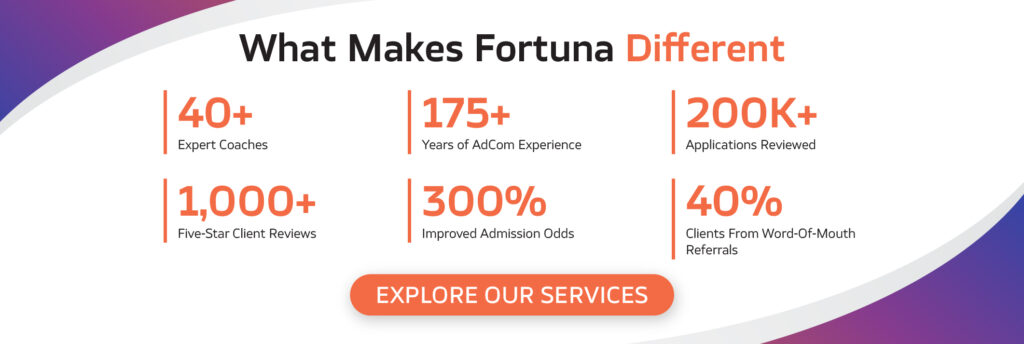
Expert Application Advice from Fortuna Coaches
Meet the veteran admissions insiders who will guide your Michigan Ross journey – explore Fortuna’s dream team.
1. Leave Your Ego at the Door.
Ross’s focus on action-based learning means you’ll work in teams from day one. The school wants leaders who can make an impact with other people, so resist the temptation to cast yourself as the hero of every application story. Think about teams that achieved exceptional results, the role you played, and what made you someone others wanted on that team. Your recommenders should reinforce those qualities too.
2. Know Ross Beyond the Website.
Ross wants applicants who understand how they would actually use the MBA. Talk with students, attend admissions events, and learn how experiences such as MAP connect to your own goals. That groundwork will strengthen your Michigan Ross MBA essays and help you articulate why Ross makes sense for you with genuine specificity.
3. Connect the Dots.
As you work through the Michigan Ross MBA application requirements, make three things easy to understand: You’re prepared for the academic rigor, you’ll contribute meaningfully to the Ross community, and your career goals are credible.
Look across your entire application and make sure the evidence is there. Your academic record and test score or quantitative-readiness statement can demonstrate academic preparation; your essays and activities can reveal how you’ll contribute; your resume, career goals, and Ross research should make your professional path convincing. Ross currently reviews applications holistically and allows applicants to fulfill its test requirement either with a standardized test or a Statement of Quantitative Academic Readiness.
4. Show Your Impact.
Ross’s action-learning philosophy tells you a great deal about what the school values. Across your resume, essays, and recommendations, go beyond describing what you did and make clear what changed because of your actions. Use numbers where they’re meaningful, but remember that impact can also be a team you strengthened, a person you supported, or a problem you helped solve.
This is especially relevant to the current second essay, which gives you three behavioral prompts to choose from, including one asking about a time your actions created a positive impact on a community or individual. Whichever prompt you select, Ross wants concrete evidence of what you’ve already done and insight into what drives you.
5. Embrace Ann Arbor.
Don’t treat location as an afterthought. Ann Arbor is central to the Ross experience: an energetic college town where much of your class arrives from somewhere else and builds community together. Think seriously about whether that immersive environment appeals to you and be prepared to explain why.
Ross also gives you access to the much larger University of Michigan community, so consider how you might take advantage of the university’s clubs, resources, traditions, and networks beyond the business school.
6. Prepare to Tell Your Story Again.
If you’re invited to interview, be prepared to communicate your story, goals, impact, and reasons for Ross clearly in conversation. Interviews are conducted blind, meaning the alumni or student interviewer sees only your resume, not your full file. Know your strongest examples well enough to discuss them naturally, and practice with someone outside your industry so jargon doesn’t get in the way of your story.
Your interview should reinforce the qualities you’ve demonstrated throughout the application: someone who can contribute to a team, reflect on their experiences, communicate clearly, and make an impact.
For a deeper dive, view Fortuna’s article: How to Prep for an MBA Interview: Strategies for Success.
Next Steps: Start Your Michigan Ross Journey
Ready to pursue Michigan Ross? Partner with Fortuna’s team of MBA admissions insiders to refine your strategy, strengthen your essays, and prepare with confidence. Book a free consultation to get started.
Frequently Asked Questions
The Multidisciplinary Action Projects (MAP) program is the signature experiential component of the Michigan Ross MBA curriculum. Every first-year MBA spends seven weeks working full-time with a team to solve a real business challenge for an organization. Students choose from 75+ projects spanning industries and geographies, providing an opportunity to explore new fields, strengthen leadership skills, and gain practical experience before their summer internship.
The 2026-27 Michigan Ross MBA essays include two required responses plus an optional essay. Essay 1 asks you to define your short-term career goal and explain how you’ll leverage Ross to achieve it. Essay 2 offers three behavioral prompts designed to reveal who you are, what drives you, and how you respond to challenges, sustain commitment, or make an impact.
With only 500 words across the two required essays, successful responses are specific and highly selective. Ross wants to see clear career direction alongside evidence that you’ll contribute to its collaborative, action-oriented community. For detailed guidance, read Fortuna’s Michigan Ross MBA Essays: Tips & Strategies and How to Create a Career Vision for Your MBA Application.
Ross is best known for combining rigorous management education with extensive opportunities to apply what you learn. Its REAL learning model includes MAP, student-run investment funds, entrepreneurial experiences, and other hands-on opportunities. Just as distinctive is the culture: Ross attracts ambitious doers who value teamwork, community, and making an impact.
The wider University of Michigan adds another dimension. MBA students become part of a major research university and a far-reaching alumni community while spending two highly immersive years in Ann Arbor.
While the various components of your Oxford application – your CV, recommendation letters, application form including current job and future career goals questions, and yoRoss graduates pursue careers across consulting, financial services, technology, healthcare, consumer goods, and other industries. According to the latest Michigan Ross MBA employment report, consulting accounted for about 34% of accepted offers for the Class of 2025, followed by financial services at about 20%, technology at 13%, and healthcare at 10%. The median base salary was $170,000, and 92% of graduates had received an offer within six months.
Ross also has considerable geographic reach: 67% of accepted offers were on the East Coast, in Chicago, or on the West Coast, demonstrating the national recruiting reach of the Michigan Ross MBA program.
The Michigan Ross MBA acceptance rate was 30% for the latest admissions cycle, according to Poets&Quants’ analysis of US News data. Ross remains highly competitive, with nearly 4,000 applications for its full-time MBA program.
Ross offers a STEM-designated Specialization in Management Science within the Full-Time MBA. Students complete the specialization within the MBA’s standard 57-credit requirement, so it doesn’t require additional tuition. International graduates who complete the specialization and meet relevant employment requirements may be eligible for the 24-month STEM OPT extension.
The latest Michigan Ross MBA class size for the Class of 2027 is 379 students, while the Ross MBA average GPA is 3.43.